Vintage 7 min read
What Is a Gate Mark on Cast Iron? (Reading a Pre-1890s Pan)
A gate mark is the scar across a pan's bottom where molten iron entered the mold. It signals roughly pre-1890s casting — here's how to read one and cook on it.
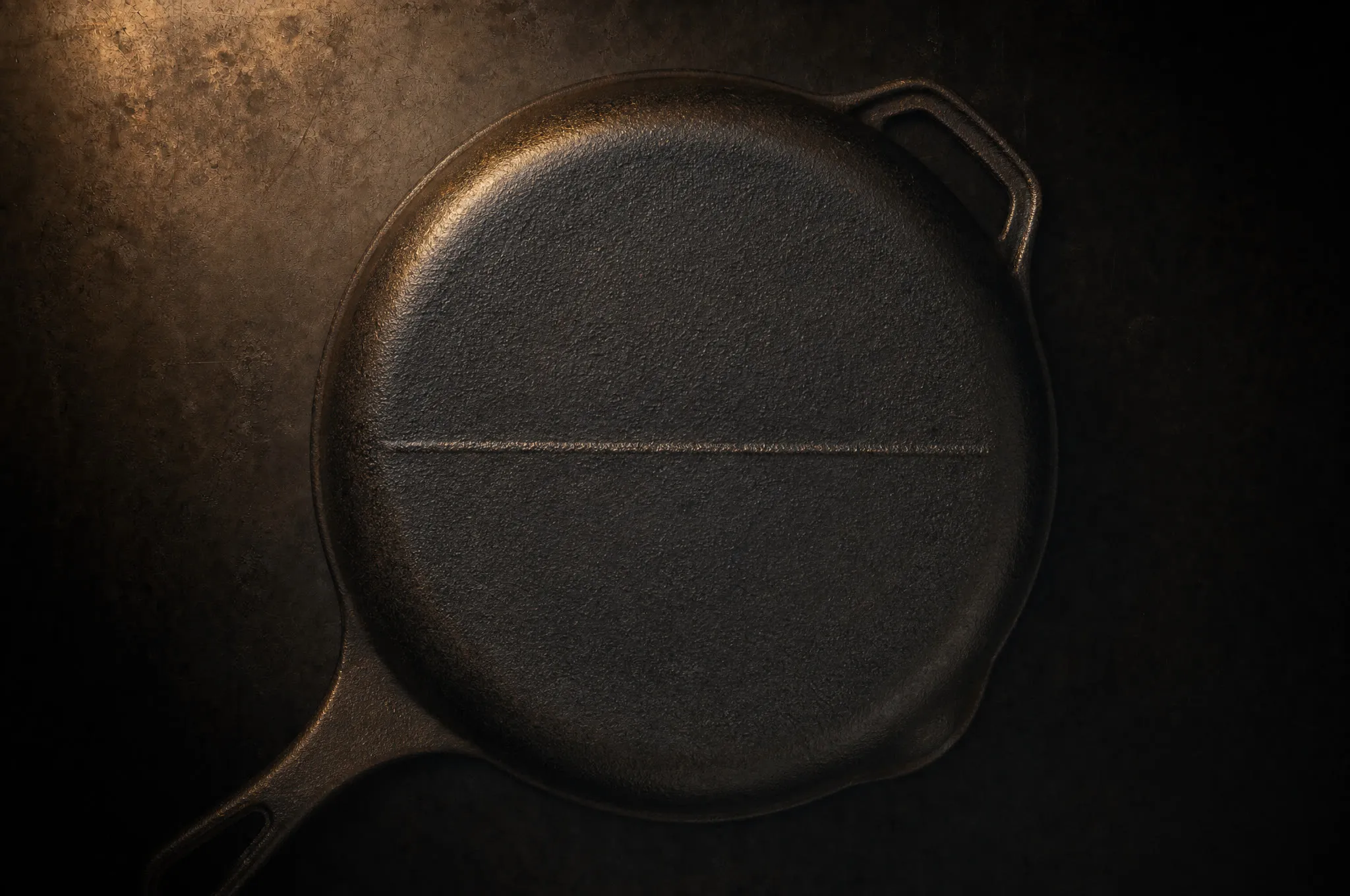
A gate mark is the rough scar — usually a straight line an inch or three long — across the bottom of a cast iron pan, left where molten iron entered the sand mold and the leftover stub was broken off and ground down. It isn’t damage. It’s a casting signature, and it dates the pan hard: American foundries abandoned the technique around the 1890s, so a gate-marked pan is genuinely antique — roughly 130 years old or more.
Here’s how to recognize one, what it does and doesn’t tell you, and how to decide whether the pan belongs on a wall or under your eggs.
What you’re looking at
Flip the pan over. A gate mark runs across the exterior bottom — most often through or near the center — as a narrow band of rough iron. Depending on the grinding, it stands slightly proud of the surface, sits flush, or dips into a shallow groove. Some earlier pieces show a round scar instead of a line. Either way the texture gives it away: it looks like a break that was filed down, because that’s exactly what it is.
The mark was never a defect. Every pan out of that foundry left with one.
Where the scar comes from
Pans of that era were cast in sand: pack fine sand around a pattern, pull the pattern out, and pour molten iron into the cavity it leaves. The iron needs a way in — a channel called a gate, fed by a funnel called a sprue — and in the early practice it entered through the bottom of the pan.
When the casting cooled, a foundry worker broke the pan free of the gate. The snap left a stub of iron on the base, which got ground down by hand — close, but never invisible. The scar is the plumbing of the pour, filed off.
Around the 1880s and 1890s — foundry by foundry, not overnight — American makers switched to gating through the side of the mold instead. Iron flowed in at the rim, stubs were ground off the side wall where nobody looks, and the bottom came out clean. Bottom-gating died, and the gate mark died with it.
What it tells you about age
One thing, loudly: this pan predates the switch. A true gate mark means iron poured roughly before the 1890s — the second half of the 1800s, possibly earlier. In nearly every case, the pan is older than household electric light.
What it doesn’t tell you: the year, the foundry, or the state it was poured in. Gate marks are a range, not a birth certificate. Getting closer than “roughly pre-1890s” takes other evidence — handle shape, size markings, mold details — and that’s the deeper end of the vintage identification pool.
Gate mark, heat ring, or machining mark?
Three different bottom features get mixed up constantly, and they mean different things:
| What you see | What it is | What it tells you |
|---|---|---|
| Rough line or round scar on the bottom, raised or ground flat | Gate mark | Bottom-gated casting — roughly pre-1890s |
| Smooth, molded-in ridge circling near the outer edge of the bottom | Heat ring | Made to seat in a wood or coal stove eye; common well into the 1900s |
| Flat swirls or straight scratch patterns, often on the cooking surface | Machining marks | Post-casting finishing — many old foundries ground their surfaces smooth |
| One thin, crisp line running up the side wall | Mold seam | Where mold halves met; sharp seams are typical of modern imports |
The heat ring deserves its own note, because it’s the identifier you’ll meet far more often — it’s the concentric ring in the Seasoned Cast logo. A heat ring says “older than a modern smooth-bottom pan,” but they stayed in production for decades after gate marks disappeared — a much looser dating signal. Gate mark: roughly pre-1890s. Heat ring: anytime before smooth bottoms took over around the mid-1900s.
A pan can carry both at once — that’s normal, and it’s still the gate mark doing the dating.
Why there’s no name on the bottom
Most gate-marked pans are anonymous, which confuses people trained to hunt logos. It’s not suspicious — it’s the era. Pre-1890s foundries were mostly regional operations pouring hollowware for general stores, hardware catalogs, and peddler wagons. Branding cookware wasn’t standard practice yet. If a gate-marked pan is marked at all, it’s usually just a size number on the handle or base.
The famous names collectors chase — Griswold, Wagner — built their reputations in the decades after gating moved to the side. So the anonymous scarred pan at the flea market isn’t a knockoff of anything. It’s from before names mattered.
What one is worth, honestly
Age does not equal value, and this is where gate-mark excitement needs a cold rinse. Because most of these pans can’t be attributed to any foundry, the collector market — which pays for names, rarity, and condition — treats them as curiosities more than trophies. A cracked or badly pitted gate-marked pan is wall decor. A clean one is a real piece of history that usually sells for less than the branded favorites made decades later.
Here’s the part that matters more if you cook: gate-marked pans are usually thinner and lighter than modern cast iron, with cooking surfaces ground smooth at the foundry. They heat up fast, respond fast, and go easy on your wrist. Plenty of people who own one call it the best-cooking skillet in the house. The market undervalues that. Cooks shouldn’t.
Checking one for cooking duty
Three checks, five minutes, before any money or restoration effort changes hands.
1. Crack check — by ear. Dangle the pan from a finger through the hanging hole, or hold the handle loosely, and rap the rim with a knuckle or a wooden spoon at several points. Healthy iron rings — a clear, brief tone. A crack kills the ring: you get a dead thud or a buzzy rattle instead. Cracks hide at the handle base and under crud, so trust your ear over your eyes.
2. Pitting check — by eye. Look at the cooking surface in raking light. Scattered shallow pits are cosmetic — seasoning fills them and food never notices. Deep, clustered pitting across the middle of the cooking surface is the kind that grabs food and harbors rust, and on a pan this thin it’s usually a pass.
3. Warp check — on glass. Set the pan on the flattest surface you have — a glass cooktop or stone counter — and press opposite points of the rim, then give it a gentle spin. Rocking under pressure means warp; an easy spin means the base is crowned. One caveat: a proud gate mark can wobble on glass even when the pan itself is dead flat. That’s the mark, not a warp — harmless on a gas grate, annoying on a flat cooktop, and not worth grinding off.
Putting one back to work
A pan that passes all three checks is a cooking pan, full stop — 130-plus years is middle-aged for cast iron. Most arrive wearing a century of rust and carbonized grease, which is a routine restoration, not a crisis. Surface rust in particular is no reason to walk away, and removing it works the same on antique iron as on last year’s pan. The full strip-to-bare-metal-and-re-season path lives in the Restore section.
One habit for a pan this old: strip gently. Lye and electrolysis dissolve buildup without touching the metal underneath. Aggressive wire-wheeling and grinding remove iron a thin antique can’t spare — and can blur the very marks that tell its story.
A gate mark is the fingerprint of a way of making things that’s been gone for over a century. The pan wearing one has outlived the foundry that poured it, the store that sold it, and every cook who owned it — and if it rings clear and sits flat, it’s ready to outlive you too. Season it and put it back on the fire.
FAQ
How old is a cast iron pan with a gate mark?
Roughly 130 years or older. American foundries phased out bottom-gating through the 1880s and 1890s, so a true gate mark puts the pan in the second half of the 1800s or earlier. Getting more precise than that takes other evidence — handle shape, size markings, mold details — because the mark itself is a range, not a date.
Does a gate mark make a pan valuable?
Not by itself. Most gate-marked pans carry no maker's mark and can't be attributed to a foundry, and the collector market pays for names and condition more than raw age. A cracked or deeply pitted example is a display piece. The honest value is in the cooking: these pans are typically thinner, lighter, and smoother than modern cast iron.
Is it safe to cook on a gate-marked pan?
Yes, if it's sound. It's the same gray iron as a modern pan, just older and thinner. Check for cracks with the tap test, pass on deep pitting in the cooking surface, then strip the old buildup and re-season before the first cook. A pan that rings clear and sits flat has decades of work left in it.
Should I grind the gate mark off so the pan sits flat?
No. The bottom of a gate-marked pan is already thin, and grinding through the mark removes metal you can't put back — and erases the one feature that proves the pan's age. If the mark wobbles on a glass cooktop, use the pan on gas or in the oven instead. The mark is the pan's birthmark; leave it.