Restore 8 min read
How to Remove Rust From Cast Iron (No Matter How Bad It Looks)
Rust almost never kills a cast iron pan. Remove it by severity — a scrub, a 50/50 vinegar bath, or electrolysis — then dry it hot and re-season thin.
This guide has product links. As an Amazon Associate, Seasoned Cast earns from qualifying purchases — it never changes what we recommend.
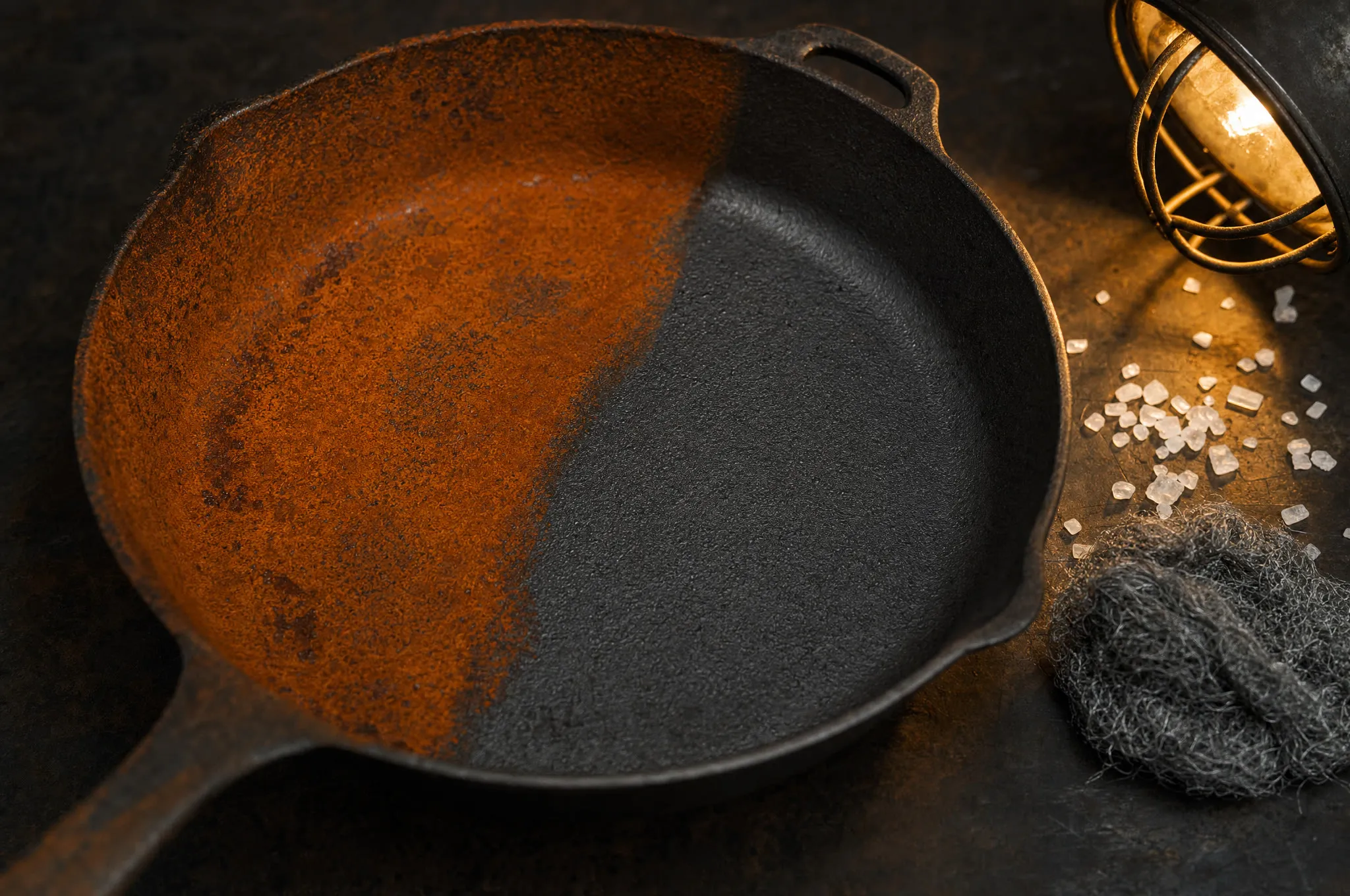
Rust doesn’t kill cast iron — it sits on top of it. Light surface rust scrubs off with steel wool in ten minutes. Moderate, all-over rust dissolves in a 50/50 vinegar bath in under an hour. Even a pan that looks like it came off the seabed usually cleans up in an electrolysis tank. Match the method to the severity, then finish every version the same way: dry the pan hot and re-season with thin coats of oil.
Here’s how to read the damage, pick the right route, and keep the rust from coming back the day after you fix it.
First, read the damage
Rust forms on the surface and works inward slowly. The question isn’t “is it rusty” — it’s “how deep.”
| What you see | What it means | The fix |
|---|---|---|
| Orange spots or dust; wipes brown onto a towel | Surface rust sitting on or in the seasoning | Scrub it off, spot-season |
| Even orange-brown layer, but the metal under it is smooth | Moderate rust, no structural harm | Vinegar bath, then re-season |
| Thick, flaky scale, often mixed with black carbon crust | Heavy rust and buildup | Electrolysis tank (lye first if it’s crusted) |
| Rough craters or pockmarks under the rust | Pitting — the only rust that counts as damage | Remove the rust, then triage the pan |
The rule that should steer every decision below: rust is cosmetic until it starts pitting. A pan can wear an ugly orange coat for years and come back to perfect cooking condition in an afternoon, because the rust is a layer, not a wound. If you’re wondering whether you can keep cooking on it in the meantime, that’s its own question — covered in is rusty cast iron safe to use.
Light rust: scrub it off today
Spots, speckles, a faint orange haze on the walls, one patch where a wet lid sat — this level doesn’t need chemistry. It needs friction.
- Scrub the rusty areas with fine steel wool under hot running water, working in circles until the orange is gone and you see clean gray metal or intact dark seasoning. A chainmail scrubber works too. Dish soap is fine and speeds things up — soap does not destroy seasoning.
- Rinse and dry the pan on a burner over medium heat until every drop of water is gone and the pan is too hot to touch comfortably.
- Wipe in a thin coat of neutral oil, then buff with a towel until the pan looks dry again. If you scrubbed down to bare gray metal on the cooking surface, give it an oven coat or two instead of calling it done — bare iron is unprotected iron.
You’ll see the half-a-potato-and-coarse-salt trick recommended for this job. It works — it’s just mild abrasion with a squirt of acid — but steel wool does the same thing faster and lets you see what you’re doing.
Moderate rust: the 50/50 vinegar bath
When the whole pan wears an even coat of rust — the classic garage-sale or left-in-the-shed pan — scrubbing alone turns into an hour of orange sludge. Acid does the bulk of the work instead. Plain white vinegar dissolves rust; your job is to control how long it gets to work.
- Mix equal parts white vinegar and water in a container big enough to submerge the whole pan, handle included. Full submersion matters: a half-dunked pan comes out with a visible line etched at the waterline.
- Check it every 15–20 minutes. Pull the pan, hit it with steel wool or a stiff brush, and look. Rust that was welded on at the start wipes away like wet chalk.
- Most pans are done in 30–60 minutes. If rust remains after an hour, don’t extend the soak — rinse the pan, scrub, and run a second short bath. Multiple short sessions with checks are safe. One long unattended session is how pans get ruined.
- When you’re down to gray metal, rinse thoroughly and get the pan onto a burner immediately. Some people add a quick rinse in baking-soda water to neutralize leftover acid first — reasonable, but the thorough rinse and the immediate drying are what actually matter.
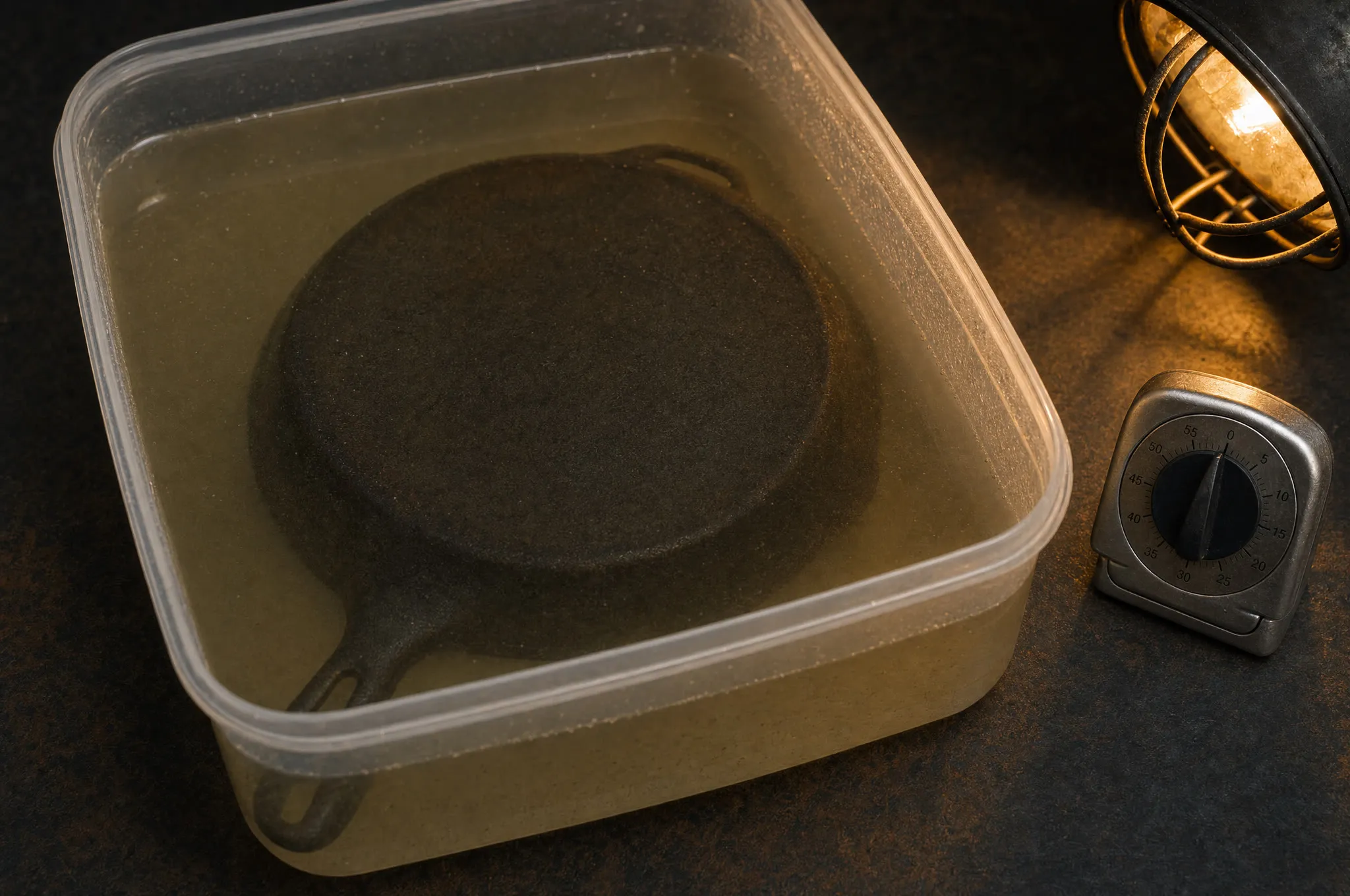
The reason for the clock: vinegar can’t tell rust from pan. Acetic acid dissolves iron oxide, and when the oxide is gone it starts on the iron underneath — first a dull gray etch, then real pitting. The acid doesn’t stop working because you got distracted.
Flash rust: the orange bloom that shows up in minutes
Pull a pan out of a vinegar bath, rinse it, turn around to grab a towel — and it’s already turning orange. That’s flash rust, and it’s not a failure. Bare iron plus water plus air starts oxidizing in minutes; there’s nothing protecting it yet. Wipe the bloom off with an oil-dampened paper towel or give it a ten-second pass with steel wool, get the pan on a burner, and move straight into seasoning. Speed is the whole defense: from final rinse to hot-and-oiled should be minutes, not hours.
The everyday version of the same chemistry: a pan that grows orange spots after normal washing. That’s not bad luck — it’s thin seasoning letting water reach iron. The fix is the after-every-cook routine: dry the pan on a burner until fully hot, wipe in a few drops of oil, buff it back to dry-looking. If spots keep appearing, the pan is telling you it needs two or three fresh oven coats.
Heavy rust: skip the marathon, go to the tank
Thick scale that flakes off in chips, rust layered over decades of carbon crust, an inherited pan that’s more orange than black — you can fight this with vinegar rounds and steel wool, but you’ll be at it all weekend and the acid-exposure clock keeps ticking. This tier is what the two full-restoration tools are for, and both are covered step-by-step in the Restore section:
- Electrolysis pulls rust off electrochemically — it converts and lifts the oxide without eating healthy iron, reaches every crevice you can’t scrub, and is far gentler than a long acid bath. For serious rust, it’s the best tool there is. Setup is simpler than it sounds: a battery charger, a bucket, and washing soda.
- Lye doesn’t remove rust — it dissolves the black carbon-and-grease crust that rust hides under. A pan that’s both crusted and rusty gets the lye bath first, then electrolysis or a short vinegar bath for whatever rust the lye uncovers.
If a pan qualifies for this section, it’s not a lost cause — it’s the most satisfying kind of project cast iron offers.
Pitting: the only rust that counts as damage
Everything above removes rust. Pitting is what rust leaves behind when it’s had years to work: small craters where oxide ate into the metal and the metal is simply gone. No treatment fills it back in. What you do about it depends on where it is:
- Shallow, scattered pits on the walls or the outside: ignore them. Season the pan and cook. Seasoning bridges and smooths minor pitting over time, and it has zero effect on how the pan performs.
- Deep pitting across the cooking floor: the pan is still safe and still useful — it’s just no longer an egg pan. Rough floors grab delicate food. Demote it to chili, braises, deep frying, and campfire duty, or hang it on the wall with a clear conscience.
Cracks and warps are what actually kill cast iron. Rust — even rust that’s started to pit — almost never does.
Every route ends the same way: dry hot, oil thin
Whatever removed the rust, you now own some amount of bare, unprotected iron, and bare iron starts rusting again the same day. The finish is not optional and it’s always the same:
- Dry the pan on a burner until it’s fully hot and every trace of water is gone.
- Re-season in the oven: wipe on a neutral oil, wipe it all off, and bake the pan upside down at 450–500°F for an hour. Two or three rounds rebuilds a working surface — the full process is in how to season cast iron in the oven.
- Keep every coat thin. A thick coat doesn’t protect better; it turns into the tacky, half-cured mess that’s the other classic way pans go wrong. If the pan looks oiled going into the oven, it’s wearing too much.
Rust is the most reversible failure in cast iron — a layer on the pan, not a wound in it. Scrub the light stuff today, clock the vinegar bath instead of trusting your memory, send the heavy cases to the tank, and finish hot and thin every time. The pan will outlive the mistake, and probably you.
FAQ
Is it safe to cook in a pan that had rust on it?
Yes, once the rust is gone. Scrub back to clean gray metal, re-season, and the pan is as good as it ever was. Cooking over a small active spot before you noticed it isn't dangerous either — rust tastes metallic and sheds orange into food, which is reason enough to remove it, but it isn't a health emergency.
Can I leave cast iron in vinegar overnight?
No. Vinegar keeps working after the rust is gone, and an overnight soak eats into the pan itself — first a dull gray etch, then pitting. Keep sessions to 30–60 minutes with a check every 15–20, and run a second short bath if you need more time. Over-soaking damage is permanent; under-soaking costs you five minutes of extra scrubbing.
Why does my pan rust again right after I wash it?
Bare or thinly seasoned iron flash-rusts within minutes of meeting water and air. Dry the pan on a burner until it's fully hot — not on a rack, not with just a towel — then wipe in a thin coat of oil. If it keeps happening, the seasoning is too thin to protect the iron: give it two or three oven coats and the problem stops.
Is a pitted pan ruined?
Almost never. Shallow pits on the walls or the outside are cosmetic — cook and ignore them. Deep pits across the cooking floor will grab food, so that pan gets demoted to chili, braises, and campfire duty rather than eggs. Cracks and warps are what actually retire cast iron; rust and pitting rarely do.